

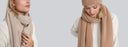
A scarf is a staple in your fall and winter wardrobe, and one you shouldn't forget when choosing outfits for colder days. Besides providing wind protection, a scarf also impacts your appearance by drawing attention close to your face. A poorly fitting scarf or a carelessly tied scarf can ruin your entire look. In this article, you'll learn how to tie a scarf and how to choose one that looks aesthetically pleasing and protects against the cold.
First, let's discuss how to read the ingredients on a label and what a good scarf should be made of. Scarves made of synthetic, artificial, and natural materials are available on the market.
- Synthetic, i.e. Polyester, Polyacrylic, Acrylic, Polyamide
- Artificial fibers will most often be Viscose or Modal
- Natural, i.e. Cotton, Wool, Merino, Cashmere, Silk, Alpaca, Mohair
Synthetic fibers look remarkably similar to natural fibers, but they're cheaper and usually very durable. Their main drawbacks are that they don't keep us warm, meaning they lack the properties we need most in the fall and winter. Another drawback of synthetic materials, especially in scarves, is that acrylic tends to attract static electricity. Viscose , an artificial material between natural and synthetic, looks good, is soft to the touch, and is quite durable, but doesn't provide as much warmth as wool. The downsides of natural materials include their higher price. Cashmere and alpaca are harder to find, making them more expensive. Wool can also be itchy. A solution in this case is to choose a softer variety of wool, like cashmere or mohair, or to add a lanolin-based detergent to your laundry.
You can read more about the types of wool and their characteristics on our blog.
How to wear a scarf?
A scarf should match the color of your jacket or coat. You can choose sets with a hat and gloves in the same color or choose matching color variations. It's worth having both plain and patterned styles in your wardrobe, as well as several scarves of varying thicknesses. This way, depending on the weather and the type of clothing, you can easily create many styles and play with different combinations.
How to tie a men's scarf and how to tie a women's scarf?
Let me tell you, it doesn't matter . Each of the methods presented below will work for both women's and men's wardrobes, as they are universal solutions that will spice up many fall and winter looks.
How to wear a scarf with a coat?
A thinner, tighter-weave scarf definitely suits a coat better. In the case of a dressing gown or diplomatic coat, the scarf is crucial because it covers the space around the neck, which is created by the intersection of the two front pieces. Therefore, it's crucial to tie the scarf properly to protect the neck and drape it nicely. This space also allows you to showcase interesting scarf draping.
How to tie a scarf to a coat?
On warmer days, to diversify your outfit and add a fashionable touch , you can simply leave the scarf hanging around your neck and wear it over your coat, under your belt, or under your coat , so that its side edge slightly peeks out from under the outerwear.

When thinking about how to tie a scarf to a coat, you don't have to go overboard. A very popular and stylish method is the simple Parisian tie, which is created by folding the scarf in half lengthwise, creating a loop on one end that is wrapped around the neck, and then inserting the end into the resulting hole and tightening it to your liking. You can find this type of scarf tiein Zosia's video – it's the first one shown.
A very chic, four-in-hand tie, inspired by tying a tie, is the four-in-hand . It begins in exactly the same way as the Parisian tie: fold it in half and wrap it around your neck. However, you only insert one end into the loop, then twist it, insert the other end into the hole, and then tighten and shape it. Detailed instructions for tying this scarf can be found here:Zosia's video .
How to wear a scarf with a hooded jacket?
A winter jacket with a large hood definitely poses a greater challenge, making the dilemma of how to tie a scarf even more difficult. However, simplicity is best in this situation. Complicated ties can overwhelm the entire silhouette, so it's worth opting for a classic wrap around the neck, tying the ends underneath, leaving one end loose, or hiding it in the folds of the fabric.
How to tie a large winter scarf?
A thick, voluminous scarf is a must-have for cold weather, as it not only adds warmth but also adds a cozy, winter touch to outfits. In this case, you don't have to worry about tying a thicker scarf, as despite its bulk, it can still be worn stylishly. The first, very easy way, which also works for jackets, is a single knot turned sideways, with one end hanging in the front and the other in the back. Because the scarf is on its side, it won't come undone as easily. You can also simply tie the scarf at the end to create a cowl, which is important to shape neatly to conceal the knot.

How to tie longer scarves?
A tie that works especially well with long scarves and holds in place perfectly can be created by wrapping the scarf around your neck once or twice, so that the two ends hang down at the same length on either side. Then, loop the ends through the loop you've created around your neck, pulling them outward and underneath, and finally forming a knot.
A scarf isn't just a practical accessory that protects against the cold, but also an element that can significantly impact the final look of our outfit. By choosing the right material and color, as well as knowing how to tie scarves and properly match them with outerwear, we can create unique looks for colder days with this wardrobe item . Therefore, when putting together your fall/winter outfit, don't forget about a scarf.

unique, solid and substantive fashion knowledge

have access to pre-sales, drops and promotions

receive a 5% code for your first purchase at ANSIN

Anna Ochman Stylist


